
African Grey Behavior
A practical guide to reading body language, preventing problem behaviors, and building a confident bond with your African Grey Parrot.
Introduction
Problem statement: One day your bird is a chatty clown, the next it is pinning its eyes and lunging. Understanding African Grey Behavior turns that mystery into a clear conversation you can respond to confidently. In this guide you will learn how to decode signals, prevent biting, support talking without stress, and address feather picking with compassion and structure.
African Grey Behavior Essentials
African Greys are highly social, highly intelligent prey animals. That combination creates predictable patterns. They scan for safety, seek social proof from their flock, and work for mental challenges. When those needs are met, you see relaxed feathers, soft body posture, playful beak contact, and exploratory vocalizations. When needs are not met, you see tension, vigilance, and displacement behaviors like pacing or shredding.
Think of behavior as information. If your Grey screams, bites, or plucks, it is communicating a need or an over-stimulated state, not trying to be difficult. The fastest progress comes from changing antecedents and consequences: set the stage to make the right behavior easy and rewarding.
Here is a helpful mental model you can apply today:
- Body state influences mood.
- Mood influences attention.
- Attention influences behavior choices.
Reading body language in context
- Eye pinning with upright stance: heightened interest or arousal. Pair with slow, predictable movements.
- Feather slicking and weight forward: possible lunge loading. Pause, step back, offer a target stick instead of your hand.
- Fluffed head and beak grinding: relaxation and safety. Great time for low-demand social time.
Side-by-Side Comparison
| Feature | Option A | Option B |
|---|---|---|
| Fast tail wag after step-up | Excitement relief or success signal | Say a bridge word and offer a tiny treat to reinforce stepping up |
| Crest-like neck elongation and stare | Scanning for threat | Increase distance, lower stimuli, and give a safe perch view |
| Chewing toes or feathers quietly | Self-soothing or boredom | Start a foraging activity and redirect to chewable toys |
| Wing quiver during approach | Ambivalent about contact | Offer target to touch instead of hands and reward calm acceptance |
Preventing and reducing biting
Biting is a late-stage message. Your work is to notice and respond earlier. Use a target stick to create a predictable communication channel and to move your Grey without hands when arousal is high. Reinforce beak-to-target touches with very small, frequent treats so the behavior becomes a safe default under stress.
Before each session, run a 30-second checklist: is the room bright but not harsh, are there escape perches available, is there an immediate reinforcement available, and can you keep the session under two minutes. End on success. Short, consistent reps beat heroic sessions.
Talking, mimicry, and healthy vocalization
Greys are legendary talkers. Encourage words and sounds you like by responding immediately and enthusiastically when they occur, especially in calm contexts. Pair preferred phrases with needs. For example, reinforce soft contact calls like a whistle you choose in the morning and evening so they replace volume spikes.
Avoid reinforcing screams by accident. Step out of view for five to ten seconds when loud, return and reinforce the moment of quiet. Consistency teaches which vocalizations produce attention.
Enrichment that prevents problems
Plan enrichment as a rotation. Build three bins: forage, shred, puzzle. Each day, deliver one item from each bin. Swap toy locations rather than adding endless new items. Novel placement refreshes engagement while keeping the space familiar.
DIY ideas: paper cup stacks with pellets inside, vine balls stuffed with leafy greens, ice cube trays as mini foraging boards. Track which textures your Grey destroys fastest and offer those in the afternoon when energy is high.
Feather Picking: Compassionate Triage
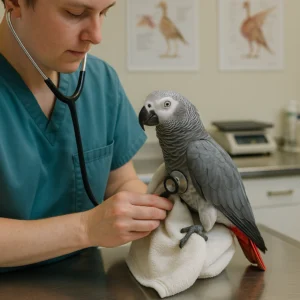
Feather destructive behavior has multiple possible causes. Start with a veterinary exam to rule out pain, parasites, dermatitis, and metabolic issues. If medical causes are addressed, shift to environmental and behavioral layers.
- Comfort layer: stable light schedule, 10 to 12 hours dark, quiet sleep space.
- Sensory layer: regular misting or access to bathing, safe humidity, chewable textures.
- Cognitive layer: daily training, foraging challenges, predictable routines.
Document baseline with weekly photos and a simple 0 to 5 scale for areas affected. Celebrate any stabilization before seeking full regrowth.
Myths, Mistakes, or Gotchas
- Myth: Biting shows dominance. Reality: Bites signal fear or confusion. Teach alternatives and adjust the environment.
- Myth: Talking replaces social time. Reality: Greys still need daily flock contact and enrichment.
- Mistake: Training when the bird is overtired. Fix: Train after rest and a small snack to improve success.
- Mistake: Ignoring quiet periods. Fix: Reinforce calm heavily so it becomes the default.
FAQs
- Q: How many hours of sleep does an African Grey need?
- A: Aim for 10 to 12 hours of uninterrupted dark and quiet. Use a consistent lights-out routine and a sleep cage if the main room is active at night.
- Q: What is a safe daily training duration?
- A: Several micro-sessions of 2 to 5 minutes each. End on a win and spread sessions across the day.
- Q: How do I stop my Grey from screaming when I leave the room?
- A: Teach a replacement contact call, reinforce quiet on your return, and practice brief out-of-sight intervals that gradually increase.
- Q: Which toys are best for Greys?
- A: Rotate chewable woods, palm leaves, paper, and puzzle feeders. Match textures to your bird’s preferences and avoid unsafe metals or loose threads.
- Q: When should I see a vet for feather picking?
- A: Immediately at onset or if intensity increases. Rule out pain and medical drivers before focusing on behavior plans.
Conclusion & Next Steps
Behavior is a language you can learn. By reading signals early, shaping with small wins, and meeting core needs, your African Grey Parrot becomes more confident and connected. Start with one habit today: a two-minute target session or a new foraging puzzle.